
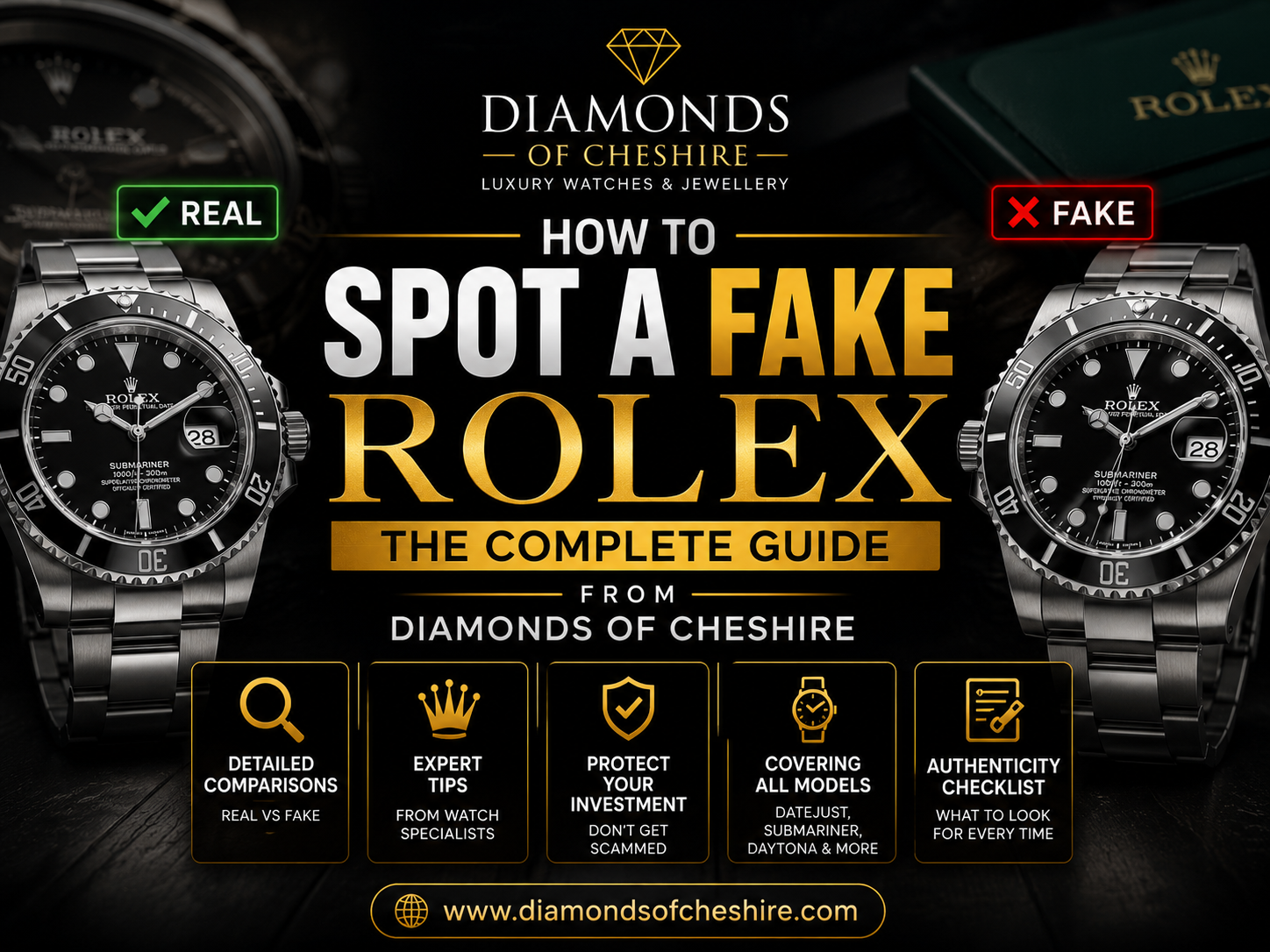
How to Spot a Fake Rolex Everything You Need to Know
Rolex is the most counterfeited luxury watch brand in the world. Every year, millions of fake Rolex watches flood global markets — from cheap tourist trinkets to high-grade "superfakes" that can fool even experienced buyers at first glance. If you're buying a pre-owned Rolex, or you're just curious whether the watch you already own is genuine, knowing the authentication signs is essential.
At Diamonds of Cheshire, we handle verified luxury watches every day. We know exactly what genuine Rolex quality looks and feels like — and we know what the fakes get wrong. This guide walks you through every key authentication check, from quick visual tests to detailed inspection points that will tell you definitively whether a Rolex is real or counterfeit.
Why Are There So Many Fake Rolexes?
The short answer is desirability. Rolex is not just a watch — it is a global status symbol that has been in continuous production since 1905. Models like the Submariner, Datejust, Day-Date, GMT-Master II, and Explorer are instantly recognisable worldwide, which is exactly why counterfeiters target them.
The fake Rolex market ranges from laughably obvious knockoffs sold for £20 on market stalls to sophisticated high-grade replicas costing hundreds of pounds that require close inspection to identify. The proliferation of "superfakes" in recent years — particularly from manufacturers in Asia — means that casual buyers, online shoppers, and even pawnbrokers have been caught out.
The price of a genuine pre-owned Rolex ranges from around £3,000 for entry-level models to well over £30,000 for rare or complicated pieces. That price gap between real and fake is enormous, which is why authentication matters so much.
The 12 Key Ways to Spot a Fake Rolex
1. The Caseback
This is one of the most reliable quick checks for a counterfeit Rolex. Genuine Rolex watches — with very few historical exceptions — have a completely smooth, solid oyster caseback. There is no exhibition window (a transparent sapphire crystal showing the movement), no engravings on the back, and no decorative patterns.
Fake Rolexes very commonly feature:
- A see-through caseback showing a visible movement (and on fakes, that movement is almost always a cheap, low-quality automatic or quartz)
- Engravings on the caseback such as model names, brand logos, or serial numbers
- A caseback that feels thin or flimsy when touched
If someone shows you a Rolex and you can see the movement through the back — it is not a genuine Rolex. The only exceptions are a small number of vintage reference pieces from the 1930s and some Cellini models, which are beyond the scope of most buyers.
2. The Weight
A genuine Rolex is substantial. The cases are made from solid Oystersteel (Rolex's proprietary 904L stainless steel), 18ct gold, platinum, or white gold. The bracelets are solid metal — not hollow.
Pick up a genuine Rolex and you feel its quality immediately. It has a dense, reassuring heft that cheap fakes cannot replicate. Most counterfeit Rolexes are noticeably lighter because they use inferior, hollow, or plated metals.
If a watch claiming to be a Rolex feels light or insubstantial in your hand — treat that as a major red flag.
3. The Second Hand Movement
This is the most frequently cited authentication test, and for good reason. Genuine Rolex watches use their own in-house automatic movements. The Rolex calibre movements tick at 6, 7, or 8 beats per second depending on the calibre — which, when viewed in real time, produces an extremely smooth, near-continuous sweeping motion of the second hand.
Fake Rolexes almost universally use cheap quartz or low-grade automatic movements. Quartz movements produce a distinct, audible tick with a noticeable step between each second — exactly what you do not see in a genuine Rolex. Some high-grade fakes use generic automatic movements that produce a rougher sweep — still noticeably less smooth than the genuine article.
Watch the second hand carefully. Smooth and near-imperceptibly continuous = good sign. Stepping, ticking, or jerky motion = not genuine.
4. The Cyclops Lens Date Magnification
On Rolex models with a date function — including the Datejust, Submariner Date, Day-Date, and GMT-Master II — a small magnifying "cyclops" lens sits above the date window on the crystal. Rolex's genuine cyclops lens magnifies the date to 2.5 times its size, making it large, clear, and very easy to read.
On fake Rolexes, the date magnification is almost always weak, blurry, or barely noticeable. The date might appear only slightly larger than normal, or it may be distorted at the edges.
Look at the date through the cyclops lens. On a genuine Rolex it should fill the entire window and be crystal clear. On a fake, it will typically look smaller and less defined than expected.
5. The Crown Logo and Engravings
At 6 o'clock on every genuine Rolex dial, just below the hands, sits a tiny Rolex crown logo. On genuine watches, this crown is laser-etched to an extraordinarily fine level of detail — it is perfectly symmetrical, with clean lines and precise points.
On fakes, this crown is often:
- Blurry or smudged
- Asymmetrical
- Too large or too small
- Printed rather than etched, giving it a slightly raised or painted appearance
Under a loupe or magnifying glass, the quality difference between a genuine Rolex crown engraving and a fake is usually obvious.
Similarly, examine all text on the dial. Genuine Rolex dials feature text that is applied (not printed) with exceptional precision — each letter is perfectly formed, consistent in size, and sharply defined. Blurry, uneven, or inconsistent lettering is a strong indicator of a counterfeit.
6. The Rehaut (Inner Bezel Engraving)
Since 2002, Rolex has engraved the serial number of the watch around the inner bezel edge — the rehaut — which is the sloped surface between the dial and the crystal. On genuine Rolexes from this era onward, this engraving features the text "ROLEX ROLEX ROLEX" repeated continuously, with the serial number at the 6 o'clock position.
On fakes, this engraving is either:
- Absent entirely
- Present but shallow, uneven, or poorly executed
- Incorrect in some detail (wrong text, wrong position, inconsistent depth)
This is a check that requires removing the bracelet and examining the rehaut closely — but it is highly reliable.
7. The Crown Winding Feel
A genuine Rolex crown (the winding crown on the side of the case) has a very specific feel when you interact with it. Rolex's Triplock or Twinlock crown system provides a smooth, precise, positive engagement — when you pull it out to set the time or wind the movement, it clicks into position with a defined, satisfying action.
On fakes, the crown often feels loose, wobbly, or cheap. The action may be gritty, imprecise, or have noticeable play. This is difficult to describe in words but immediately obvious when you handle both a genuine and fake side by side.
8. The Bracelet and Clasp
Rolex bracelets — whether Oyster, Jubilee, President, or Pearlmaster — are made from solid metal links. They have a specific, dense feel and a smooth, precise articulation between links. The clasp systems (Oysterlock, Crownclasp, etc.) are complex, precisely engineered mechanisms.
Fake Rolex bracelets are typically:
- Hollow rather than solid (much lighter)
- Less precisely finished, with visible tool marks or rough edges
- Less smooth in articulation — links may feel gritty or imprecise
- Poorly finished at the clasp, with cheap mechanism and poor tolerances
Examine the underside of the bracelet closely. Genuine Rolex links have clean brushed or polished finishes on every surface. Fakes often have rough finishing on hidden surfaces.
9. The Bezel
On models with rotating bezels — such as the Submariner, GMT-Master II, and Explorer II — the bezel action on a genuine Rolex is precise and crisp. The Submariner's unidirectional bezel clicks into position with a sharp, defined click for each of its 60 positions. The action is smooth but firm.
On fakes, the bezel typically:
- Feels loose or imprecise
- Produces a different, less defined click
- May rotate in both directions when it should only rotate in one
- Has inferior finishing on the ceramic or aluminium insert
10. The Serial and Model Numbers
Between the lugs of a genuine Rolex (the small projections on the case that hold the bracelet), you will find the serial number on the 6 o'clock side and the model (reference) number on the 12 o'clock side. These require removing the bracelet to see.
On genuine Rolexes, these engravings are laser-etched to a fine, consistent depth with a characteristic "ice cube" appearance — the numbers appear sharp and three-dimensional rather than flat.
On fakes, these engravings are often:
- Sandy or grainy in texture rather than ice-cube sharp
- Shallow and flat
- Incorrectly formatted (wrong reference numbers for the stated model)
Cross-reference the reference number with the correct format for the claimed model year and variant.
11. The Hologram Sticker (Vintage Models)
Rolex fitted hologram stickers to the casebacks of their watches between approximately 1985 and 2002. These stickers featured a Rolex crown logo and a unique serial number. On genuine watches, these holograms show a distinctive three-dimensional depth and colour shift when tilted.
On fakes of this era, the hologram sticker is typically flat, has poor colour shift, or is reproduced at a different scale or quality. Be aware that many genuine watches have had their original stickers removed over time — the absence of a sticker is not proof of inauthenticity, but a present sticker should look right.
12. The Price — If It Seems Too Good, It Is
Genuine Rolex watches — even worn, unboxed, pre-owned examples — hold their value extraordinarily well. A pre-owned Rolex Submariner in reasonable condition will typically sell for £7,000–£10,000 in today's market. A Datejust might start from £3,000–£4,000.
If someone is offering you a "Rolex" for £500, £800, or even £1,500 through an informal channel — it is not real. The counterfeit market is sophisticated enough to produce watches that look convincing at a glance, and they are often sold at prices that seem like a "great deal" to buyers who don't know the genuine market value.
Always buy from a reputable, verified source.
The Safest Way to Buy a Genuine Rolex
The surest protection against counterfeit Rolexes is buying from a trusted, reputable source that has authenticated the watch. At Diamonds of Cheshire, every pre-owned Rolex and luxury watch in our inventory is verified before it is offered for sale. We handle genuine timepieces every day — we know the real thing inside and out.
Whether you're buying your first Rolex or adding to an existing collection, purchasing from an established dealer gives you the peace of mind that no private sale or online marketplace can guarantee.
Browse our current watch collection at diamondsofcheshire.com — or get in touch directly if you have questions about authenticating a specific piece.
Diamonds of Cheshire — Luxury Watches & Jewellery, Cheshire, UK. Every watch in our collection is verified and authenticated.