
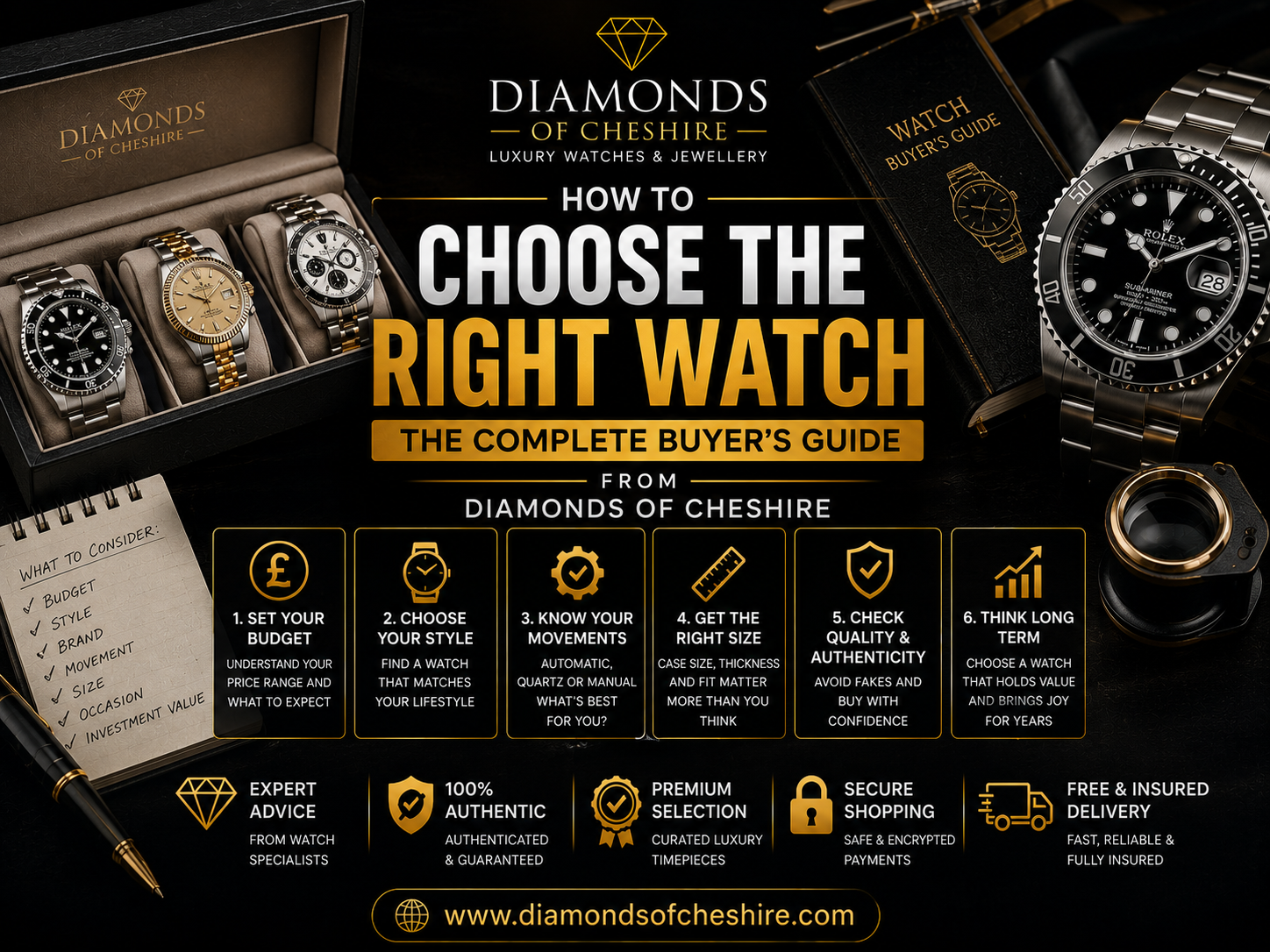
Buying a watch is one of the most personal purchasing decisions you can make. Unlike most accessories, a watch is worn every day, seen by everyone you meet, and often kept for decades — or passed down through generations. Getting the choice right matters.
The challenge is that the watch market is enormous. Thousands of brands, tens of thousands of models, price points from £100 to £100,000 and beyond, and a bewildering array of technical specifications that can feel impossible to navigate if you're not already deep in the hobby.
At Diamonds of Cheshire, we help people find the right watch every day. This guide distils everything we know about watch buying into a practical, honest framework — so you can make a decision you'll be proud of for years to come.
Step 1: Set Your Budget Honestly
The first and most important step in choosing a watch is setting a realistic budget. Not an aspirational budget. Not "what I'd spend if I had unlimited money." A budget you are genuinely comfortable with.
The watch market has excellent options at every price point, and buying a more expensive watch than you can comfortably afford rarely leads to satisfaction. What matters far more than price is buying the right watch at whatever budget you have.
Budget Tiers | What to Expect
Under £500 At this level you're looking at fashion watches (Emporio Armani, Tissot entry-level, Seiko) and solid everyday Japanese movements. Seiko in particular represents extraordinary value — their SKX series and 5 Sports range are mechanical watches with decades of proven reliability at sub-£300 prices.
£500–£2,000 The mid-range luxury tier where Swiss movements start appearing at competitive prices. Tissot's Le Locle and PR516 models, TAG Heuer's Formula 1 series, Longines Conquest, and Frederique Constant all live here. These are proper Swiss watches with genuine horological credibility.
£2,000–£5,000 Entry-level prestige. Omega's Seamaster 300 and Aqua Terra, TAG Heuer Carrera, Tudor Black Bay, and Breitling Colt all operate in this space. This is where watch buying becomes genuinely exciting — these are watches that hold their value and have real collector interest.
£5,000–£15,000 Serious luxury. Rolex Datejust, Omega Speedmaster, IWC Pilot's Watch, Panerai Luminor, Jaeger-LeCoultre Reverso. These are watches that will last a lifetime, hold significant resale value, and carry serious prestige.
£15,000 and above Investment-grade horology. Rolex Submariner, GMT-Master II, Day-Date, Patek Philippe Calatrava, Audemars Piguet Royal Oak. At this level, the watch is both a luxury item and a genuine financial asset.
Step 2: Define the Purpose
What is this watch actually for? This question shapes everything — the size, the style, the movement type, and the brand.
Everyday Wear
If you want a single watch to wear every day — to the office, to dinner, to the weekend — you need versatility above everything else. The ideal everyday watch is well-proportioned (38–42mm for most wrists), on a metal bracelet or a robust leather strap, water-resistant to at least 100m, and styled neutrally enough to work with both formal and casual dress.
Classic everyday choices: Rolex Datejust, Omega Aqua Terra, Tudor Black Bay, Longines Conquest, Tissot Le Locle.
Dress Watch
A dress watch is worn specifically with formal attire — suits, black tie, smart evenings. The ideal dress watch is slim, modest in size (36–40mm), on a leather strap, and as simple in design as possible. A clean white or cream dial, simple hour markers, and no excessive complications.
Classic dress watch choices: Jaeger-LeCoultre Reverso, Rolex Datejust (on leather), Patek Philippe Calatrava, Omega De Ville, Cartier Tank.
Sports Watch
A sports watch needs to be robust, legible, water-resistant, and confident in active environments. The best sports watches combine technical functionality with a design language that still looks exceptional in non-sporting contexts — one of the great achievements of watchmaking.
Classic sports watch choices: Rolex Submariner, Omega Seamaster Professional, Breitling Superocean, TAG Heuer Aquaracer, Tudor Pelagos.
Casual / Lifestyle Watch
For relaxed, everyday casual wear where technical precision is less important than style and personality, the market offers enormous variety. Brands like Bell & Ross, Hublot (Big Bang), and Richard Mille cater to bold statements; vintage-inspired pieces from Hamilton, Longines, and Seiko offer more restrained character.
Step 3: Choose Your Movement Type
A watch movement is the engine inside the case. Understanding the difference between movement types helps you choose the right watch for your lifestyle and priorities.
Mechanical (Manual Wind)
The original watch movement. A mechanical watch is powered entirely by a hand-wound mainspring — you wind it manually, typically daily, using the crown. Mechanical watches are beloved for their intimate relationship with the wearer and their extraordinary engineering. They require slightly more attention but reward that attention with a connection to the craft of watchmaking that no other movement can replicate.
Best for: watch enthusiasts, vintage watch lovers, people who appreciate tradition and craftsmanship.
Automatic (Self-Winding)
An automatic movement is a mechanical movement with an added rotor — a weighted semicircle that spins with the motion of your wrist, winding the mainspring automatically as you wear the watch. Wear it regularly and it never needs manual winding. Leave it unworn for several days and it will need to be wound to restart.
The vast majority of luxury watches in the £2,000+ price range use automatic movements. Rolex, Omega, TAG Heuer, IWC, and most serious Swiss brands all use in-house or high-grade automatic calibres.
Best for: everyday wear, people who want the beauty of mechanical watchmaking without the daily winding discipline.
Quartz
A quartz movement uses a battery-powered oscillating quartz crystal to regulate timekeeping. Quartz movements are extraordinarily accurate (typically +/- 15 seconds per month versus +/- 5 seconds per day for a good mechanical), require almost no maintenance, and are far cheaper to produce than mechanical movements.
At the luxury end, quartz watches (including Grand Seiko Quartz and Breitling Superquartz) represent excellent timekeeping in prestigious cases. At the entry level, a quality quartz watch is a perfectly sensible choice.
Best for: practicality, accuracy, low maintenance, budget-conscious buyers.
Solar/Kinetic
Solar-powered watches (Citizen Eco-Drive being the leading example) convert light into stored electrical energy. Kinetic watches generate electricity from wrist movement. Both offer quartz accuracy without battery replacement. Excellent practical choices at mid-range prices.
Step 4: Size and Proportions
A watch that doesn't fit your wrist properly will never look right, no matter how good the quality. Getting the size right is essential.
Case Diameter
- Under 38mm: considered a smaller, more vintage-inspired size. Very elegant on slimmer wrists; may look underwhelming on larger wrists
- 38–42mm: the mainstream luxury sweet spot. Works across a wide range of wrist sizes
- 42–46mm: larger, bolder. Works well on larger wrists; can dominate smaller ones
- Over 46mm: statement sizes, often associated with sport/diver styles
Lug-to-Lug Distance
Case diameter alone doesn't tell the full story. The lug-to-lug measurement (the distance across the case from top to bottom lug) determines how the watch sits across the wrist. A watch with wide lugs will overhang a narrow wrist significantly.
Case Thickness
For dress watches, slimness is a virtue — a slim watch disappears elegantly under a shirt cuff. For sports watches, some thickness is acceptable and often adds to the robust character. Be conscious of how a watch will wear under your cuffs if you dress formally.
Step 5: Brand and Heritage
In the luxury watch market, brand matters. Not purely for status, but because brand is inseparable from quality standards, after-sales service, parts availability, and long-term value retention.
Rolex
The world's most recognised luxury watch brand. Exceptional build quality, outstanding value retention, and a global service network. The Submariner, Datejust, and GMT-Master II are among the best investments in the watch world. Rolex is the safe choice — universally respected, never dated.
Omega
The second most prestigious Swiss watch brand. Official timekeeper of the Olympics and the watch of James Bond. The Seamaster and Speedmaster are iconic. Omega offers better availability than Rolex at comparable prices and has strong value retention. Excellent movement quality since the co-axial escapement revolution.
TAG Heuer
Swiss sports watchmaking heritage with strong motorsport associations. The Carrera and Monaco are collector favourites. TAG offers a more accessible entry into Swiss luxury than Rolex or Omega and has strong brand recognition.
Breitling
Aviation and professional instrument watchmaking. Large cases, highly legible dials, robust construction. The Navitimer and Superocean are iconic. Breitling appeals to those who want genuine technical character in their watch.
Tudor
Rolex's sister brand — built in Rolex cases with in-house Tudor movements. Offers Rolex-adjacent quality at significantly lower prices. The Black Bay series in particular represents extraordinary value in the luxury sports watch market.
IWC
Swiss luxury with a distinctive design language — understated, functional, and extremely well-made. The Pilot's Watch and Portofino series are perennial classics. IWC is a favourite of people who want luxury without conspicuous branding.
Step 6: New vs Pre-Owned
This is one of the most important decisions in watch buying, and the answer is almost always: buy pre-owned if you can.
Here is why:
Immediate value drop on new watches. A new watch depreciates the moment you leave the boutique — just as a new car does. Buying pre-owned means someone else has absorbed that initial depreciation. You pay closer to the real market value.
Better availability. Certain Rolex and Patek Philippe models have years-long waiting lists at authorised dealers. Pre-owned market availability is far better.
History and character. Pre-owned watches often come with stories, original boxes and papers, and a character that new watches lack. Many collectors specifically seek out lightly worn pre-owned pieces.
Value retention. A well-chosen pre-owned watch in good condition retains its value — and in the case of hot Rolex and Patek references, may appreciate over time.
At Diamonds of Cheshire, our entire inventory is authenticated pre-owned luxury watches and jewellery — meaning every piece we sell has been verified, inspected, and priced fairly based on real market conditions.
Bringing It All Together | Our Recommendation Framework
Use this simple framework when making your decision:
- Set your budget — be honest and stick to it
- Define the purpose — everyday, dress, sport, or casual?
- Choose your movement — automatic for most people; quartz for practicality
- Get the size right — measure your wrist, try before you buy if possible
- Choose your brand — consider heritage, value retention, and service network
- Buy pre-owned — from a verified, reputable dealer
The right watch is the one you'll reach for every morning without hesitation. It should fit your life, your wrist, your style, and your budget. When all of those align — that's the right watch.
Browse our full collection of verified luxury watches at diamondsofcheshire.com, or get in touch with our team for personalised guidance.
Diamonds of Cheshire — Luxury Watches & Jewellery, Cheshire, UK. Every watch in our collection is verified, authenticated, and fairly priced.